

The Incoterms rules or International Commercial Terms are a series of pre-defined commercial terms published by the International Chamber of Commerce (ICC) that are widely used in International commercial transactions or procurement processes. A series of three-letter trade terms related to common contractual sales practices, the Incoterms rules are intended primarily to clearly communicate the tasks, costs, and risks associated with the transportation and delivery of goods.
The Incoterms rules are accepted by governments, legal authorities, and practitioners worldwide for the interpretation of most commonly used terms in international trade. They are intended to reduce or remove altogether uncertainties arising from different interpretation of the rules in different countries. As such they are regularly incorporated into sales contracts worldwide.
First published in 1936, the Incoterms rules have been periodically updated in 1953, 1967, 1976, 1980, 1990, 2000, 2010, with the latest version — Incoterms® 2020 — in force since 1 January 2020.
Key changes vs Incoterms 2010: the term DAT (Delivered at Terminal) has been renamed and broadened to DPU (Delivered at Place Unloaded); under CIP the seller must now provide insurance with the higher level of cover (Institute Cargo Clauses A — "all risks") instead of the minimum cover; under FCA the buyer can instruct the carrier to issue an on-board bill of lading to the seller; the rules now explicitly address transport-related security requirements.
Below are short descriptions of the 11 rules from the Incoterms® 2020 edition.
Official ICC Incoterms® 2020 practical wallchart (reproduced without alteration, English).
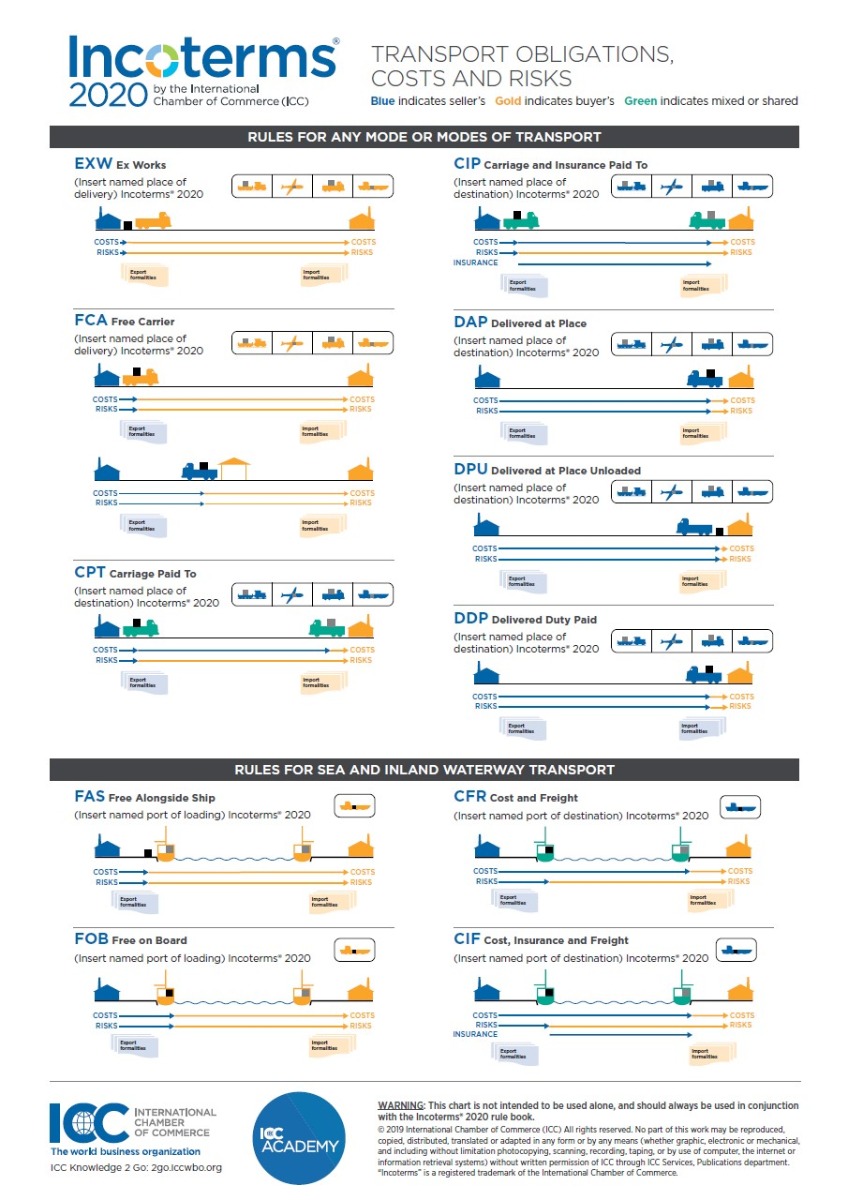
Incoterms® and the Incoterms® 2020 logo are trademarks of ICC. Use of these trademarks does not imply association with, approval of or sponsorship by ICC unless specifically stated above. This chart is not intended to be used alone and should always be used in conjunction with the Incoterms® 2020 rule book.
Download the free PDF from ICC
Rules for any mode or modes of transport.
EXW - "Ex Works" means that the seller delivers when it places the goods at the disposal of the buyer at the seller’s premises or at another named place (i.e.,works, factory, warehouse, etc.). The seller does not need to load the goods on any collecting vehicle, nor does it need to clear the goods for export, where such clearance is applicable.
FCA - "Free Carrier" means that the seller delivers the goods to the carrier or another person nominated by the buyer at the seller’s premises or another named place. The parties are well advised to specify as clearly as possible the point within the named place of delivery, as the risk passes to the buyer at that point.
CPT - "Carriage Paid To" means that the seller delivers the goods to the carrier or another person nominated by the seller at an agreed place (if any such place is agreed between parties) and that the seller must contract for and pay the costs of carriage necessary to bring the goods to the named place of destination.
CIP - "Carriage and Insurance Paid to" means that the seller delivers the goods to the carrier or another person nominated by the seller at an agreed place (if any such place is agreed between parties) and that the seller must contract for and pay the costs of carriage necessary to bring the goods to the named place of destination.
Under Incoterms® 2020, the seller is required to obtain insurance at the higher level of cover — Institute Cargo Clauses (A) or equivalent "all-risks" terms. The minimum-cover requirement only applies to CIF for bulk maritime trade.
DPU - "Delivered at Place Unloaded" (the renamed and broadened DAT from Incoterms 2010) means that the seller delivers when the goods, once unloaded from the arriving means of transport, are placed at the disposal of the buyer at a named place of destination — which can be any place, not only a terminal (quay, warehouse, container yard, road, rail or air cargo terminal, or the buyer's own facility). The seller bears all risks involved in bringing the goods to and unloading them at the named place.
DAP - "Delivered at Place" means that the seller delivers when the goods are placed at the disposal of the buyer on the arriving means of transport ready for unloading at the named place of destination. The seller bears all risks involved in bringing the goods to the named place.
DDP - "Delivered Duty Paid" means that the seller delivers the goods when the goods are placed at the disposal of the buyer, cleared for import on the arriving means of transport ready for unloading at the named place of destination. The seller bears all the costs and risks involved in bringing the goods to the place of destination and has an obligation to clear the goods not only for export but also for import, to pay any duty for both export and import and to carry out all customs formalities.
Rules for sea and inland waterway transport.
FAS - "Free Alongside Ship" means that the seller delivers when the goods are placed alongside the vessel (e.g., on a quay or a barge) nominated by the buyer at the named port of shipment. The risk of loss of or damage to the goods passes when the goods are alongside the ship, and the buyer bears all costs from that moment onwards.
FOB - "Free On Board" means that the seller delivers the goods on board the vessel nominated by the buyer at the named port of shipment or procures the goods already so delivered. The risk of loss of or damage to the goods passes when the goods are on board the vessel, and the buyer bears all costs from that moment onwards.
CFR - "Cost and Freight" means that the seller delivers the goods on board the vessel or procures the goods already so delivered. The risk of loss of or damage to the goods passes when the goods are on board the vessel. the seller must contract for and pay the costs and freight necessary to bring the goods to the named port of destination.
CIF - "Cost, Insurance and Freight" means that the seller delivers the goods on board the vessel or procures the goods already so delivered. The risk of loss of or damage to the goods passes when the goods are on board the vessel. The seller must contract for and pay the costs and freight necessary to bring the goods to the named port of destination.
'The seller also contracts for insurance cover against the buyer’s risk of loss of or damage to the goods during the carriage. The buyer should note that under CIF the seller is required to obtain insurance only on minimum cover. Should the buyer wish to have more insurance protection, it will need either to agree as much expressly with the seller or to make its own extra insurance arrangements."
Quick reference — 11 Incoterms® 2020 rules.
Any mode of transport (7): EXW, FCA, CPT, CIP, DAP, DPU, DDP.
Sea and inland waterway transport only (4): FAS, FOB, CFR, CIF.
Terms removed since Incoterms® 2000.
The following rules are no longer in force and should not be used in new contracts: DAF, DES, DEQ, DDU (removed in Incoterms 2010), and DAT (renamed to DPU in Incoterms 2020). For existing contracts that still reference an old version, the chosen Incoterms edition must be specified explicitly, e.g. "FOB Odesa, Incoterms 2010".
Incoterms rules are not law — they are a set of guidelines published by the International Chamber of Commerce and become binding only when both parties explicitly reference them in the sales contract. Always state the version, for example: "CIF Odesa, Incoterms® 2020".
N.B. Transfer of the freight-cost obligation and transfer of risk do not always occur at the same time — review each rule carefully.


